Architecture
A guided tour of the code for a new contributor. It names the processes, the modules and what each one owns, then follows one watch from the moment a client reports it to the moment a note lands in Anki. The domain words (source, platform, tracker, judge, 判定) are defined in GLOSSARY.md; the user-facing overview is in the README.
Before you change anything, read CONTRIBUTING.md: it says which checks to run for which kind of change, and what a PR must report.
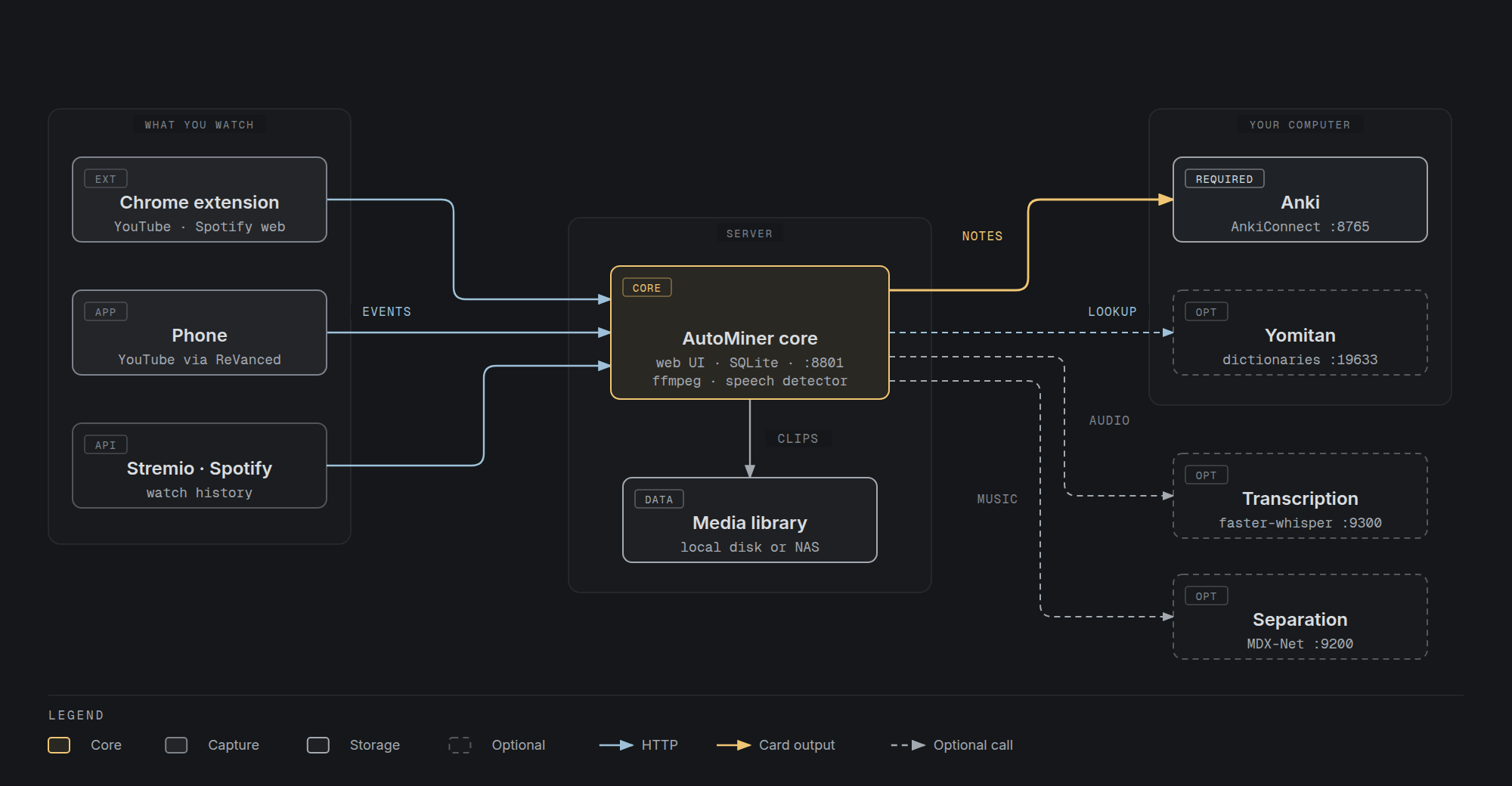
Processes
Section titled “Processes”AutoMiner is one server process plus clients and optional services. The server owns all state: the database, the job queue, the media library and every clip. Clients only report what was watched; Anki is read for known words and receives finished notes.
The core server
Section titled “The core server”autominer serve (cli.py) runs uvicorn with the
FastAPI app in app.py, on 0.0.0.0:8801 by default.
On Windows the installer starts the same app through
desktop.py (python -m autominer.desktop), on
127.0.0.1:8801.
The app’s lifespan does the startup work, then starts everything else inside
the same process:
| Part | Where | What it does |
|---|---|---|
| HTTP API and web UI | app.py |
Every route (see HTTP API), plus the static pages under /static. |
| Job worker | jobs.start_worker |
One thread, autominer-worker, that claims and runs one job at a time. |
| Trackers | trackers.py | A supervisor thread that starts one thread per installed platform that has a tracker (Stremio and Spotify today) and re-checks every 30 s. |
| One-time passes | app._one_time_passes |
A thread that runs a few one-time data upgrades after start, then warms the Sources list; the worker waits for the upgrades. |
| Built-in Yomitan | yomitan_local.py | A Node child process running yomitan/server.mjs on a free local port, when enabled. |
| Local judge | local_judge.py | A llama-server child process from a pinned llama.cpp build, started the first time the local judge is asked a question once its files are downloaded. |
Startup, in order: db.init_db creates or upgrades the schema (and refuses a
database too old to upgrade, see The database), the built-in
Yomitan starts, the job handlers are registered, and a series of repair and
backfill steps run (clip score backfill, automine.settle, orphan thumbnail
sweep, unfinished dictionary imports, line-join sweep, held judge work,
loudness queues, disk measurement). Each step logs and carries on if it fails.
Shutdown stops the trackers, then asks the worker to finish its current job
within 30 s (jobs.WORKER_JOIN_TIMEOUT_S).
A tracker is a client like any other: it posts to POST /v1/events over HTTP at
AUTOMINER_CORE_URL, which serve points at itself unless you set it. Each
tracker takes a file lock, $AUTOMINER_HOME/state/<platform>-tracker.lock, so
two cores sharing one home never track the same platform twice; the second one
reports standby. /healthz lists each tracker’s state.
Scheduled jobs outside the server
Section titled “Scheduled jobs outside the server”The Raspberry Pi deployment in deploy/ adds systemd timers that run
short separate processes: the database backup
(scripts/operations/backup_db.py),
autominer qa-purge --commit, autominer retention-sweep --commit, and the
yt-dlp update (deploy/update-ytdlp.sh). The
deployment commands are in the command line
reference; scheduling these jobs is in upkeep.
Clients
Section titled “Clients”| Client | Code | Door |
|---|---|---|
| Chrome extension | extension/ | POST /v1/events |
| YouTube on Android (Morphe patch) | android/morphe-patches/ | POST /v1/ingest/youtube-android |
| Stremio and Spotify trackers | adapters/, run in the core | POST /v1/events |
| Windows relay agent (legacy fallback) | extension/agent/ | forwards to POST /v1/events |
Every door checks the producer first; see producer admission.
Off-box services
Section titled “Off-box services”The core talks to these over HTTP. None is required to start; a feature whose service is missing reports not configured, and work that needs it is skipped or held with the reason.
| Service | Used for | Configured by |
|---|---|---|
| Anki with AnkiConnect | known words, duplicate checks, sending notes (anki.py) | anki.url / ANKICONNECT_URL |
| Yomitan API (or the built-in one) | definitions, readings, frequency, card format (yomitan.py) | yomitan.url / AUTOMINER_YOMITAN_URL |
| Probe transcription, probe_asr/ | blind transcription of short audio windows for the 判定 (probe_asr.py) | evidence.asr_url / AM_PROBE_ASR_URL |
| Vocal separation, separator/ | removing music before listening (separation.py) | sync.separation_url / AM_SEPARATOR_URL |
| Search (Prowlarr or an addon), Deluge, VPN proxy | getting Stremio media (acquire/) | acquire.indexer_url, acquire.deluge_url, vpn.proxy_url |
| Cloud APIs | transcription (OpenAI, ElevenLabs Scribe), translation (OpenAI, Gemini), the hosted judge Jev, Jimaku, OpenSubtitles | secrets such as OPENAI_API_KEY, TYPESAFE_API_KEY |
gpu_gateway/ packages the separator and the probe transcriber behind one URL for testing on a rented GPU. Installing and running the services: self-hosting.
Main modules
Section titled “Main modules”All server code is the autominer package in core/autominer/.
Most modules are flat files; a few areas are subpackages
(repository layout says where new work belongs). The
tables below group the modules by what they own.
HTTP, process and configuration
Section titled “HTTP, process and configuration”| Module | Owns |
|---|---|
| app.py | Every HTTP route, the startup and shutdown sequence, the /v1 token check, the “database busy” 503 answer. |
| cli.py | The autominer command (command line): serve, doctor, setup, secret, producers, maintenance, repair scans and sweeps. |
| desktop.py, launcher.py | The Windows desktop launcher; autominer install-command. |
| settings_registry.py | Every installation setting and secret: name, type, default, feature, help. |
| service_urls.py | Which URL each service uses: environment, saved row or default. |
| config_setup.py, doctor.py, help_text.py, dependencies.py | autominer setup, the doctor report, CLI help, and the Settings rules that refuse a value another setting needs. |
| db.py, schema.sql | Connections, schema creation, migrations. |
| maintenance.py, release.py, revision.py, backup.py | The admission barrier used during deploys, the restart gate, the running revision, the last backup’s record. |
| admission.py, producers.py | Producer admission at the ingestion doors and the record of admitted clients. |
| qa.py, wipe.py | Marking test (QA) sources and purging them; erasing everything. |
| ports.py, pinned.py | A free local port; downloading pinned programs (yt-dlp, its PO-token provider and plugin, llama.cpp) by checksum. |
Job queue and freshness
Section titled “Job queue and freshness”| Module | Owns |
|---|---|
| jobs.py | The queue: enqueueing, claiming, running, retrying, cancelling; the table of job kinds and handlers. |
| jobruns.py | The job_run history table, filled by triggers on job. |
| progress.py | A job’s progress (stage, done, total, message) and the job view the UI polls. |
| versions.py | The version number of each stage and the files each one covers. |
| freshness.py | What a source’s results were built from, which inputs are stale, the stages that fix them. |
| converge.py | The Fix button: running stages until a source is fresh or held for a named reason. |
| costs.py | Spend limits for paid calls; holding and releasing jobs at a limit. |
Capture and the watch ledger
Section titled “Capture and the watch ledger”| Module | Owns |
|---|---|
| ingest.py | Validating an event envelope, finding or creating the source, the session and the event row, and queuing the first job. |
| revanced.py | The Android door: its shared secret and turning a phone report into an envelope. |
| trackers.py, adapters/spotify.py, adapters/stremio.py | Running the in-process trackers; reading Spotify and Stremio playback. |
| ledger/intervals.py | Turning a session’s events into watched intervals. |
| ledger/session_sweep.py | Closing sessions that never sent session.end. |
| ledger/stats.py | Watch-time statistics, the Sources list rows and each source’s freshness verdict. |
| dashboard.py, devices.py | The Today page’s cards and layout; device names and colors. |
| dedupe.py | Spotting the same title already mined under another source. |
Platforms and getting media
Section titled “Platforms and getting media”| Module | Owns |
|---|---|
| platforms/ | The Platform interface (interface.py) and the built-in platforms: YouTube, Stremio, Spotify, Jellyfin (a stub without fetching). Install state lives in platform_install. See platforms. |
| fetch.py | The shared fetch step that YouTube’s and Stremio’s fetch jobs run: language, details, media, subtitles, then the hand-off to transcription or mining. Spotify’s fetch job gets the episode audio and hands it straight to transcription. |
| fetch_yt.py | yt-dlp, YouTube refusals and pauses, and the mine job handler. |
| fetch_stremio.py, acquire/, vpn.py | Stremio: Jimaku subtitles, torrent search and Deluge downloads, the VPN check. |
| fetch_rss.py | Podcast RSS feeds for Spotify episodes. |
| media_actions.py, sources.py, retention.py | Per-source actions (mine now, re-mine, language change, fetch video), deleting and reviving sources, deleting old videos. |
| anime_mapping.py, episode_match.py | Mapping anime episodes between numbering schemes; matching files to episodes. |
| artwork.py, channels.py, sized.py, frames.py, video.py | Thumbnails, channel and series art, resized images, extracted frames, range-served video and VTT. |
Subtitles and the timing check (判定)
Section titled “Subtitles and the timing check (判定)”| Module | Owns |
|---|---|
| segments.py | Parsing subtitle files into segment rows; subtitle filters; the source’s subtitle offset. |
| extract_subs.py, jimaku.py, animetosho.py, opensubtitles.py | Embedded tracks and the outside subtitle providers. |
| subtracks.py, subpool.py, subcache.py, subupdate.py | The subtitle files a source holds, the pool of candidates gathered for the 判定, cached copies, reloading from the original file. |
| asr.py | Transcription when there are no subtitles: providers, costs, the asr job. |
| judge.py, evidence.py, reads.py, judge_pick.py | The 判定: sampling audio windows, transcribing them, comparing with each subtitle candidate, the verdict and the pick. |
| judge_service.py, jev.py, local_judge.py, judge_setup.py | Which judge answers (Jev or the local judge, see the judge), asking it, downloading and removing the local one. |
| subsync.py, words.py, linejoin.py | Timing runs and their undo, word-level positions, joining lines that are one sentence. |
| separation.py, vad.py | Vocal separation; the speech detector. |
| replay_judge.py | Replaying stored 判定 evidence for evaluation. |
The 判定 has its own long document: subtitle sync.
Mining
Section titled “Mining”| Module | Owns |
|---|---|
| mine.py | Mining one source: watched lines only, filters, candidates, then enrich and the 判定. |
| tokenize.py, lang/ | Tokens and target-word rules; the language profiles (language profiles). |
| known.py | Known words, read from Anki or a CSV. |
| mining/score.py, mining/aggregate.py | The sentence score; grouping candidates by word and choosing the one to send. |
| mining/quality.py | Asking the judge whether a sentence is usable. |
| mining/recalculate.py | Rebuilding a source’s candidates (recalculation). |
| mining/target_form.py, mining/wordkey_sanity.py | Scans and repairs for bad target forms and word keys. |
| exclusions.py | Lines excluded from mining. |
Cards, clips and Anki
Section titled “Cards, clips and Anki”| Module | Owns |
|---|---|
| candidates.py | Candidate rows: listing, editing, decisions, deletion. |
| enrich.py | The enrich and assets.recut jobs: dictionary, translation, clip and screenshot. |
| assets.py, peaks.py | Cutting clips and screenshots with ffmpeg, clip windows, loudness, context audio; waveform peaks (clip trimming). |
| verify.py, clipscore.py, music.py | Scoring each clip with the clip model in models/, user OK/NG feedback, music-drowned clips. |
| clipmanager.py, clipquery.py | The Clips table, its search language, the trash. |
| audit.py, audit_scan.py | The Audit page: notes in Anki missing a sentence or clip, and their alternatives. |
| automine.py | Each card’s derived status, the send gates, the queue of cards to send, immediate and daily sending. |
| push.py, kiku.py | Building note fields and sending a note; the note type’s field mapping. |
| anki.py, duplicates.py, anki_same.py | AnkiConnect calls; existing notes for a word (merge, overwrite, new) and links to sent notes; checking that the open Anki profile is the one AutoMiner sent to, by finding enough of its sent notes there. |
| yomitan.py, yomitan_local.py, dictionaries.py, dictsource.py, commons_audio.py | The Yomitan API and the built-in Yomitan, imported dictionaries, the dictionary order per language, word audio. |
| translate.py, gemini.py | Sentence translation and its cost log. |
| selfhost_bundle.py | The zips Settings offers for the self-hosted services. |
The job queue
Section titled “The job queue”Every unit of background work is a row in the job table, run by the worker
thread. A row is unique per (kind, key); the key is usually a source’s
media.id, sometimes a candidate id or a fixed word like anki or all.
Kinds and lanes
Section titled “Kinds and lanes”jobs.KINDS maps each kind to its handler (module:function) and a lane.
Platforms add their own fetch and video kinds (fetch.yt, fetch.video,
fetch.stremio, fetch.rss, fetch.audio) through platforms.jobs(); those
run only while their platform is installed, and are skipped with a reason
otherwise.
| Lane | Value | Kinds |
|---|---|---|
PRESS |
0 | Work a person is waiting for: subtitles.reload, anki.sync, source.delete, maintenance.wipe, acquire.tidy. |
CHAIN |
1 | The pipeline: mine, asr, enrich, the other subtitles.* kinds, sync.*, assets.recut, candidates.*, verify.*, automine.push, media.lang, judge.fetch, platform fetches and more. |
BULK |
2 | Background passes: session.sweep, known.refresh, audit.scan, loudness, music checks and more. |
A payload can carry "lane": 0 to jump a job to the front; the routes a person
presses do this.
How a job runs
Section titled “How a job runs”- Enqueue.
jobs.enqueueinserts a row, or returns the existing one withduplicate: true.enqueue_oncereturns the live (queuedorrunning) row if there is one, else replaces a settled row with a new one.enqueue_againmarks a running job to run once more when it finishes. During a deploy drain new work is inserted held (hold = 1); seeautominer maintenancein the command line. - Claim. Each turn,
claim_nextpicks the oldestqueuedrow withhold = 0in the lowest lane, skipping kinds that must wait for upstream work on the same key (jobs.WAITS_FOR: for exampleenrichandassets.recutwait for any subtitle, mining or 判定 job of the same source). It setsstatus = 'running'and incrementsattempt. - Run. The handler gets
(conn, row). It reports progress withprogress.job_hook, which merges{"progress": {stage, done, total, message}}intopayload_json. - Settle. The outcome is the row’s final
statusplus its last progress message:
| Handler result | Status | Notes |
|---|---|---|
| returns | done |
|
raises SkipJob |
skipped |
for example a platform that is not installed |
raises CancelJob, or a cancel was requested |
cancelled |
POST /v1/jobs/{id}/cancel; a running job stops at its next check |
raises RetryLater |
queued, hold = 3 |
parked with backoff: 30 min, doubling to 6 h; failed after 3 days, unless the error names a cause: then it keeps retrying and is also released early when that cause clears (as when the judge becomes ready); Waiting names its own wait |
raises BudgetHeld |
queued, hold = 2 |
waits until costs.release_held sees room under the spend limit |
database locked (mine, enrich, assets.recut, candidates.recalc, media.lang) |
queued |
retried up to 3 attempts |
| any other exception | failed |
the message is the error, cut to 300 characters |
A job left running by a crash is marked failed at the next start, except
media.lang, candidates.rescore and judge.fetch, which are queued again.
When the queue is empty, the worker runs its idle ticks instead (reading Anki
again when due, automatic sending, music checks, trash purge, releasing the
files of deleted sources, platform ticks, budget and retry releases, torrent
tidy, audit, history pruning) and sleeps 5 s. Every turn also runs
automine.send_due and converge.tick.
History
Section titled “History”Triggers installed by jobruns.install copy every claim, requeue, settle and
delete of a job row into job_run: one row per attempt with queued, released,
started and finished times, lane and final message. Rows older than 30 days are
pruned hourly. jobruns.stats summarizes wait and run times per kind.
GET /v1/jobs/active is how the UI shows progress; see HTTP API.
From a watch to an Anki note
Section titled “From a watch to an Anki note”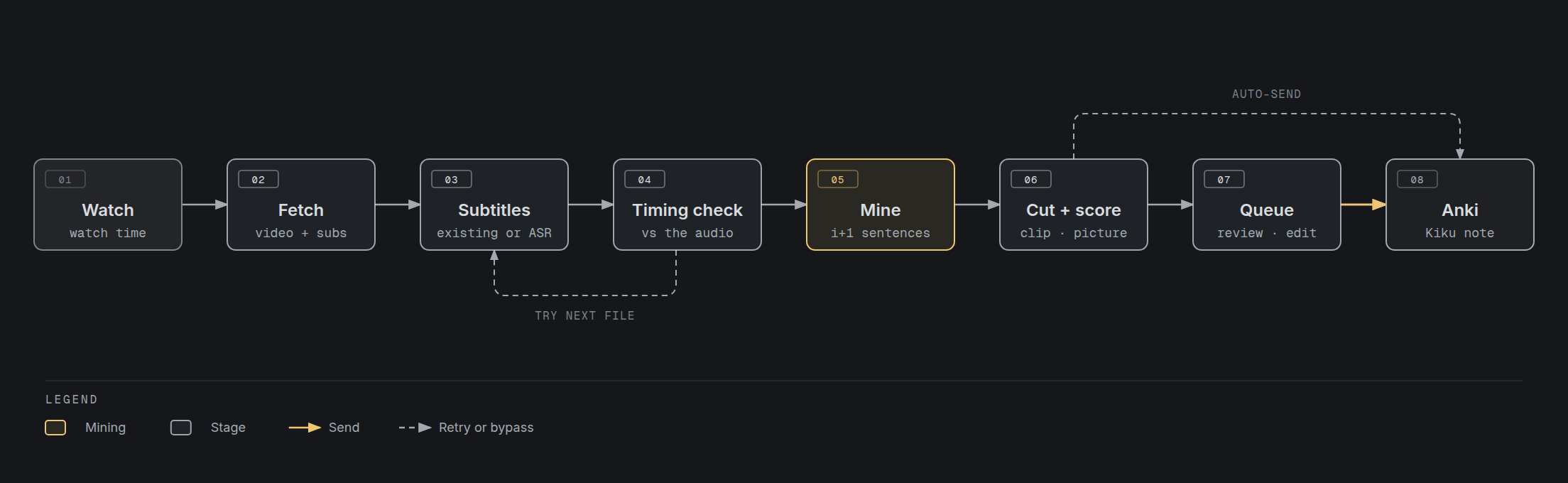
| Step | What happens | Where |
|---|---|---|
| 1. Report | A client posts an event envelope (session.start, position, pause, resume, seek, session.end). The door checks the producer. |
app.post_event, admission.guard |
| 2. Record | The envelope is validated, the source found by alias or created (media, media_alias), the session opened, and the event appended to events with an idempotency key. A position, pause, resume, seek or end recomputes the session’s intervals. |
ingest.ingest, ledger/intervals.py |
| 3. Dispatch | On session.end: if the platform is mined (mine.enabled) and the same title is not already mined as another source, queue mine again for a source that already has lines and mines only what was watched, or else the platform’s fetch job. |
ingest._dispatch_mining_job, mine.kind_enabled, dedupe.py |
| 4. Fetch | For YouTube and Stremio, the shared fetch step learns the language and details, gets the media, and looks for subtitles: the platform’s own, tracks embedded in the file, then outside providers. Lines go into segment. With no usable subtitles it hands off to asr. A Spotify episode’s fetch gets its audio and hands off to asr directly. |
platforms/, fetch.py, segments.py, asr.py |
| 5. Mine | With mine.watched_only on, for a platform that reports positions (YouTube, Spotify), only lines inside watched intervals are mined; otherwise every line is. Each line is tokenized, unknown words are found against the known-word cache, sentences are scored and grouped per word, and one per word is chosen to send (gold, 金). What the mine consumed is recorded. It then queues enrich and starts the 判定. |
fetch_yt.handle_mine, mine.py, tokenize.py, known.py, mining/, freshness.record_mined |
| 6. 判定 | The timing check gathers subtitle candidates, transcribes short audio windows, and asks the judge whether the lines were spoken where each candidate says; it records the verdict and ranks the candidates. Then it measures where each word is spoken. Kinds: subtitles.pool, sync.evidence, sync.judge, sync.words. Details: subtitle sync. |
subpool.py, judge.py, evidence.py, probe_asr.py, judge_service.py, words.py |
| 7. Enrich and cut | Dictionary entries, translation, and the clip (.mp3) and screenshot. Cutting waits for upstream work on the source (WAITS_FOR); clips for cards not about to be sent can be deferred and cut when a card is opened. |
enrich.py, yomitan.py, translate.py, assets.py, vad.py |
| 8. Score the clip | Each cut is scored by the clip model; music-drowned and quiet clips can be held back. | verify.py, clipscore.py, music.py |
| 9. Send | Cards that pass the gates are queued as automine.push jobs, now or at the daily time. The note’s fields are built, media stored, and the note added or updated through AnkiConnect; the link goes into anki_link. A person can also send from the editor. |
automine.queue_due, automine.handle_push, push.py, duplicates.py, anki.py |
A card’s status is derived, not set: automine.settle computes it from the
mined status, the person’s status, Anki links, known words and the send gates.
Freshness, stage versions and Fix
Section titled “Freshness, stage versions and Fix”A source’s results are built from inputs: its subtitles, the known words, the gold settings, the clip offsets, the audio track, the code of each stage. When an input changes, the results built from it are stale. Three modules keep that honest.
Stage versions
Section titled “Stage versions”versions.py holds one integer per stage
(PARSE, JUDGE, WORDS, VERIFY, MINE) and COVERED, the files whose
code each stage’s results depend on. Stored results carry the version they were
built with, and a different current version makes them stale.
core/tests/test_stage_versions.py
hashes each stage’s covered files (comments and docstrings removed) and
compares the hash and version with
core/tests/stage_versions.json. Any change
to a covered file fails the test until you decide: if the stage’s results from
the same inputs change, bump its number in versions.py; either way, record
the new hash in the JSON.
Stale means fixable
Section titled “Stale means fixable”freshness.record_mined stores what a mine consumed in the setting
freshness.mined:<media_id>. freshness.stale_inputs compares that and the
other records with the current state and names what moved: gold, known,
mine, offset, timeline, clip_offsets, trim_rule, judge,
lazy_gold, track, words, sync, parse, parse_lost, subs.
Each name belongs to exactly one stage in freshness.STAGES. A stage has a
fixer that queues the work that clears it, the job kinds it watches while that
work runs, and the stages it feeds:
| Stage | Stale names | Fix | Feeds |
|---|---|---|---|
parse |
parse |
queues subtitles.reload in the press lane |
mine, sync, words, clips, judge |
parse_lost |
parse_lost |
starts a 判定 pass that gathers the candidates again | mine, words, clips, judge |
mine |
subs, mine |
queues candidates.recalc (re-mine) |
sync, clips, judge |
sync |
sync |
starts a 判定 pass | words, clips, judge |
words |
words |
queues sync.words, or a re-measure when the stored words are outdated |
clips, judge |
known |
known |
queues anki.sync |
clips, judge |
gold |
gold |
re-picks gold in place and queues cuts for new picks | clips, judge |
clips |
offset, timeline, clip_offsets, trim_rule, lazy_gold |
queues assets.recut |
judge |
track |
track |
queues verify.measure for the audio track |
judge |
judge |
judge |
queues verify.judge_missing (score unscored clips) |
That is the rule: a stale state must be one its Fix clears.
test_every_stale_name_has_exactly_one_stage_and_a_node in
test_converge.py fails a name with no
stage. The one state Fix cannot clear, parse_lost on a source that cannot be
judged here, is shown as held with the reason, not as stale.
Fix converges
Section titled “Fix converges”Pressing Fix (POST /v1/fix) only records intent: converge.press writes
fix.press:<media_id> with a generation number and keep_edited, and lifts
budget and retry holds on that source’s queued jobs. The worker’s
converge.tick, every 5 s, then steps each pressed source:
- If any of the source’s stage jobs is running or queued unheld, wait.
- Compute the verdict (
ledger.stats.source_verdict) and take the first owed stage that can be fixed. If its upstream jobs are held, the phase iswaiting, with the hold named (deploy, budget, retry). - If that same stage is still owed after its own run settled, stop as
heldwith the reason: stopped, failed, skipped, refused, outage, or no progress. - Otherwise run its fixer and count a step. After twice as many steps as
there are stages it stops as
held(a loop); a fixer that raises stops it asfailed. - Nothing owed and nothing pending: the press is dropped and the source is
fresh. Only an unfixable stage owed:
held. Checks still pending (trim measurements) show ascheckingfor up to 2 h, thenheld.
The run’s state is kept in fix.run:<media_id>. converge.view turns it into
the fix object each Sources row carries, and GET /v1/fix/graph returns the
node graph the UI draws (freshness.GRAPH).
Re-mining and what it keeps: recalculation.
Settings and secrets
Section titled “Settings and secrets”There are three stores. Configuration covers them in full.
- Installation settings are declared in
settings_registry.py: name, type,
default, whether it is secret, which feature it belongs to, help.
.env.exampleis generated from it, and every consumer reads through it at call time. Platforms declare their own settings on thePlatform. - Secrets are files, one per secret, under
$AUTOMINER_SECRETS_DIR, written byautominer secret set,autominer setupor Settings. An environment variable of the same name wins over the file, and<NAME>_FILEpoints at a file elsewhere. They never go into the database.settings_registry.secret(name)reads them. - The
settingstable holds what the web UI edits, and also state the app keeps for itself (Fix runs, clip windows, pass markers and many more).PUT /v1/settings/{key}refuses those app-state keys with 403. A few settings accept a per-source-kind value askey:<kind>, such asautomine.threshold:youtube.
Service URLs are both: a saved row and an environment variable.
service_urls.resolve decides which wins: the environment, except for Anki’s
URL, where the saved row wins. The Settings page itself is described in
settings.
The database
Section titled “The database”SQLite, one file at AUTOMINER_DB (default $AUTOMINER_HOME/autominer.db).
db.connect turns on WAL, foreign keys and a 5 s busy timeout. db.init_db
creates missing tables from schema.sql, adds
missing columns, and installs triggers. schema.sql is not the whole column
list: columns added later (for example media.deleted_at, the media.channel_*
columns, anki_link.profile) are added by db._COLUMN_MIGRATIONS, so read
both.
A database last started before the upgrade commit named in
db.UPGRADE_THROUGH is refused at startup with that commit’s name. A request that still meets a locked database gets HTTP 503 with
Retry-After: 5.
| Table | Holds |
|---|---|
media |
One source: platform, title, language, platform IDs, subtitle offset, sync state, retention and QA flags. |
media_alias |
Every <platform>:<id> name of a source, primary or redirect. |
session |
One watch session on one device, open or closed. |
events |
Every accepted event envelope, append-only, with its idempotency key. |
interval |
Watched spans derived from a session’s events. |
segment |
Subtitle lines on the source’s timeline, with their origin and how well each was heard. |
segment_word |
Where each word of a line is spoken. |
candidate |
A mineable sentence for one target word: text, clip, screenshot, scores, decision, status. |
clip_feedback |
Events about a clip: plays, OK and NG checks, saves, sends, with the clip model’s score. |
gone_decision |
The accept or reject of a card that was replaced or deleted, so its day still counts it. |
cue_exclusion |
Lines excluded from mining. |
anki_link |
Which Anki note a candidate became, in which profile, and how. |
anki_whole_write |
The last whole-note write per note and Anki profile. |
anki_seen |
Notes seen per AnkiConnect URL and profile. |
anki_note |
A cache of Anki notes by expression. |
known_word |
Known words, per scope. |
known_word_note |
Which notes made a word known. |
job |
The queue, one row per kind and key. |
job_run |
The history of every job attempt (created by jobruns.install). |
settings |
Key-value settings and app state. |
platform_install |
Installed platforms. |
asr_cost_log |
Paid transcription spend. |
translation_cost_log |
Paid translation spend. |
sync_run |
One timing run of a source: before and after, evidence, undo data. |
deploy_admission |
The deploy barrier’s state (one row). |
ingest_client |
Producers the core admitted, as evidence for the restart gate. |
producer_policy |
The admission mode (one row). |
producer_enrollment |
Producer identities an operator approved. |
producer_rejection |
A bounded count of refused producers. |
line_join |
The judge’s answers on whether two lines are one sentence. |
yomitan_answer |
Cached Yomitan API answers. |
dictionary, dictionary_term, dictionary_freq |
Imported dictionaries, their entries and frequency ranks. |
sentence_quality |
Cached sentence-quality verdicts. |
input_gen |
A change token per source and for clip settings, renewed by triggers (created by db.py). |
The web UI
Section titled “The web UI”The core serves the UI from core/static/; there is no build
step. Each page is a plain HTML file that loads plain scripts with <script src>, and the scripts share globals. Page routes such as /today and
/sources return the HTML; /static/* serves the rest. Both are sent with
Cache-Control: no-cache, must-revalidate, so a deploy shows up on reload.
| File | Role |
|---|---|
today.html, queue.html, sources.html, audit.html, clips.html, lines.html, spend.html, verifier.html, settings.html, setup.html |
The pages (the pages). |
| shell.js | Shared by every page: navigation, api(), t(), patchHtml, job polling, maintenance banner, formatting helpers. |
| ui.js | Shared widgets: chips, tags, column pickers, table headers. |
editor.js, player.js, sync.js, neighbors.js |
The card editor, audio player, subtitle-timing panel, neighbor lines. |
motion.js, swipe.js, scroll-keep.js, qtable.js, audit-config.js |
Animation, touch gestures, scroll keeping, the queue table, the audit settings. |
native.js |
Plays clips through window.AutoMinerNative when the page runs in a host that provides it. |
shell.css, editor.css, motion.css, qtable.css |
Styles. |
Helpers every page uses:
api(path, opts)fetches, turns an error body (errors,detailordetail.message) into anApiError, shows a held-for-deploy notice, and marks the pressed control busy while the request runs.patchHtml(el, html)updates a region in place instead of replacing it, so polling does not reset focus or scroll.t(ja, vars, ctx)translates. Japanese strings are the source; English comes fromglobalThis.I18N_EN, filled by i18n_en.js and the per-page files in i18n/.translateStatictranslates the page’s static markup. The language is the settingui.lang, mirrored inlocalStorage(autominer_ui_lang).
JavaScript is linted with ESLint (npm run lint, config in
eslint.config.js).
The Chrome extension
Section titled “The Chrome extension”extension/ is a Manifest V3 extension.
content_video.js (driven by each platform’s Site) and
content_spotify.js watch the player and build
event envelopes; background.js keeps them in a
persistent outbox in chrome.storage.local and posts them to
POST /v1/events, oldest first, one at a time. It sends
X-AutoMiner-Client: extension, its contract number and build. A refusal with
scope: "producer" keeps the outbox and backs off; an envelope the core
rejects as bad (400, 404, 422) is moved to a set-aside list. The popup (popup.html)
takes the core URL and shows the outbox state. Installing and using it:
Chrome extension. Refusals:
producer admission.
The Android client
Section titled “The Android client”android/morphe-patches/ is a Morphe patch bundle
for the YouTube app, built with Gradle on its own. The patch reports playback
(playing, paused, ended with position, duration, title and channel)
through a persistent outbox to POST /v1/ingest/youtube-android, with the
shared secret in X-AutoMiner-Secret. The core turns each report into an
ordinary envelope (revanced.py). Setup:
YouTube on Android.
Tests live in core/tests/ and run with pytest from the repository root. Folders are named for behavior:
| Folder | Covers |
|---|---|
adapters/ |
Trackers, the Stremio and Spotify adapters, anime identity, the extension’s scope, the Android door. |
ledger/ |
Intervals, session sweeps, statistics and Today. |
media/ |
Jobs, assets, clips, 判定, freshness and Fix. |
mining/ |
Candidates, scoring, gold, duplicates, sending to Anki. |
sources/ |
Acquisition, transcription, subtitles and joins, podcasts, recalculation. |
operations/ |
Admission, the deploy guard, audit, CLI, doctor, spend, the desktop launcher. |
ui/ |
The web pages: their scripts run in Node, and static checks of the markup. |
| root | Shared conftest.py, cross-area tests, browser probes, guards. |
conftest.py isolates every test: it clears every
registry setting from the environment, gives each test its own
AUTOMINER_HOME, turns Yomitan off, treats every platform as installed (the
platform_installs fixture restores the real check), and blocks program
downloads (program_downloads restores them). API tests use FastAPI’s
TestClient on autominer.app.app with a temporary database.
Run a targeted test while you work, then the checks CONTRIBUTING.md asks for:
python -m pytest core/tests/media/test_converge.py -qpython -m pytest core/tests -q -k "freshness and not mobile"Browser tests. UI tests in ui/ cut named functions out of the static
scripts (t_prelude.py) and run them in Node.
The *_probe.js files at the root drive real pages in Playwright’s Chromium,
found through AUTOMINER_CHROMIUM. Without Node, Playwright or Chromium they
skip, and a skip is missing coverage, not a pass. Setup for the phone suite
(-k mobile) is in CONTRIBUTING.md.
Guards. Some tests check rules rather than behavior:
- test_no_comments.py: no comments or docstrings in code (AGENTS.md).
- test_stage_versions.py: a decision for every stage code change.
- operations/test_producer_admission.py:
every ingestion route calls
admission.guardfirst. - media/test_converge.py: every stale name has a stage.